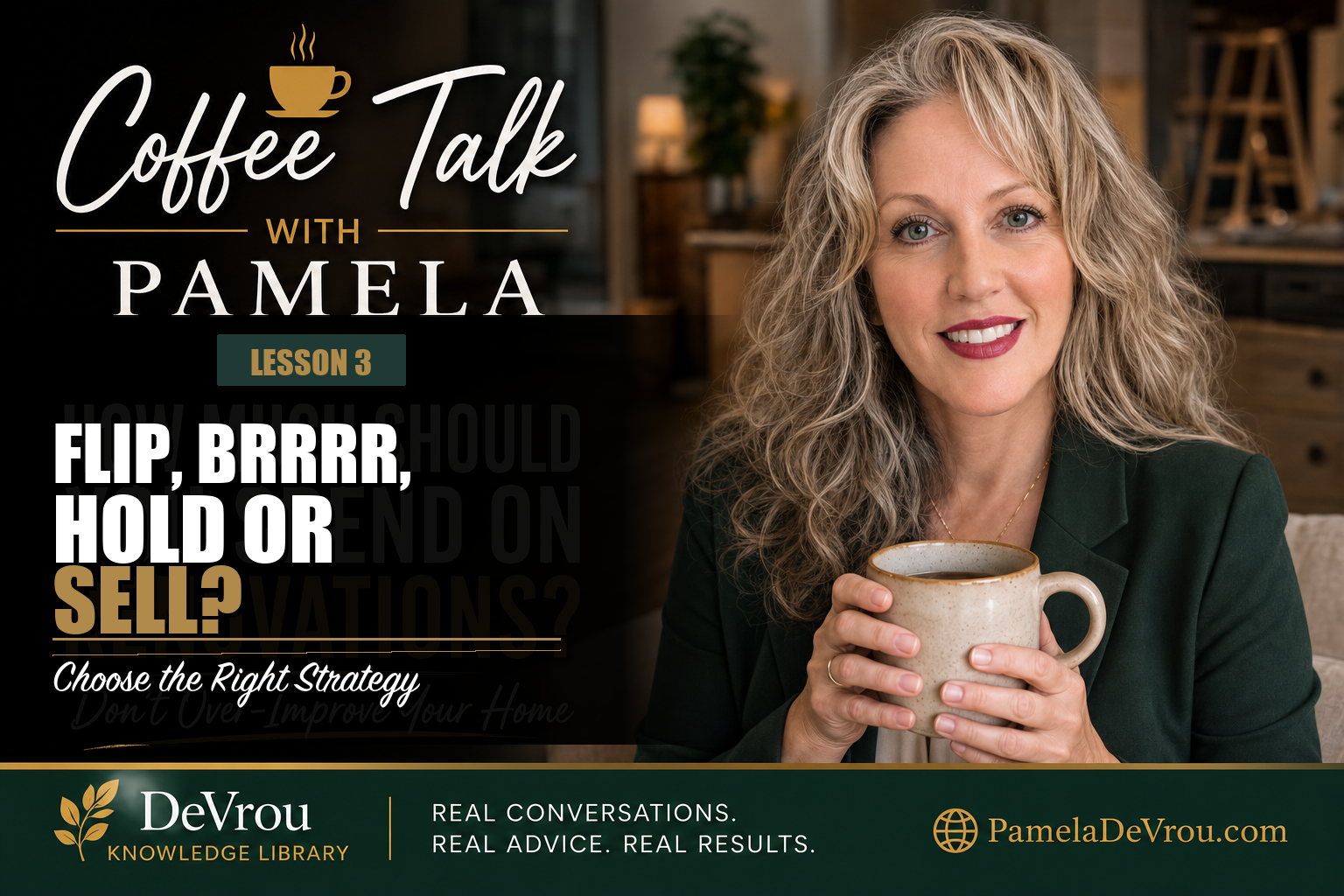
What Is The Best Property Investment Strategy?
How to Choose the Right Investment Strategy for Your Property.
Welcome back to Coffee Talk with Pamela DeVrou.
This week, we’re getting into a bigger investment conversation:
When you have a property, what should you actually do with it?
Should you:
- Sell it as-is?
- Flip it?
- Hold it?
- Use the BRRRR strategy?
The truth is, there is not one right answer for every property or every person.
The numbers may look the same on paper, but your best strategy depends on your:
- Goals
- Timeline
- Finances
- Risk tolerance
- Life circumstances
- Experience with real estate
That is why the better question is not just:
“What can I sell this for?”
The better question is:
What is the highest and best use of this property?
The Same Property Can Have Different Answers
One of the biggest mistakes people make in real estate is assuming there is one “best” strategy for every property.
But the truth is, the same property can have different answers depending on the person holding it.
A homeowner who needs cash quickly may make a very different decision than someone who has reserves, time, and a long-term investment mindset.
A family inheriting a property may choose a different path than an investor looking for long-term asset growth.
A seller who wants simplicity may choose differently than someone willing to improve, rent, or hold the property for future value.
That is why strategy matters.
Before deciding what to do, it helps to look at the property through several different lenses.
Option 1: Sell the Property
Sometimes selling is the right move.
If you need the money, do not want to manage the property, or simply need a clean transition, selling may make the most sense.
But even then, the question becomes:
Should you sell as-is, or should you prepare the home before going to market?
That depends on:
- The condition of the home
- The neighborhood
- Buyer expectations
- Comparable sales
- The potential return on any improvements
Option 2: Flip or Improve Before Selling
A flip does not always mean a full renovation.
Sometimes it means making strategic improvements that help the property compete better in the current market.
That may include:
- Fresh paint
- Updated flooring
- Improved lighting
- Minor repairs
- Landscaping
- Staging
- Better photography and video
The goal is not to improve everything.
The goal is to improve the right things.
Especially in today’s market, sellers are not only competing with other traditional homes. They may also be competing with investor-renovated properties that are staged, photographed beautifully, and presented in a way that feels move-in ready.
That does not mean every seller should renovate.
It means every seller should evaluate the numbers before deciding.
Option 3: Hold the Property
Sometimes the best decision may be to hold the property.
If the neighborhood is growing, development is moving in, demand is increasing, or the property is located in an area with strong long-term potential, holding may create more value over time.
This is especially true when the property can cover itself through rent.
Holding is not passive by accident. It requires:
- Planning
- Reserves
- Management
- A clear understanding of risk
But when the numbers work, holding can turn a former home into a long-term asset.
Option 4: BRRRR the Property
BRRRR stands for:
- Buy
- Rehab
- Rent
- Refinance
- Repeat
Many people think of BRRRR as something only investors do when buying new properties. But homeowners may also be able to think this way with a property they already own.
If you have equity, a favorable interest rate, and a property that could rent well, it may be worth asking whether selling is truly the only option.
Ask yourself:
- Could the home be improved enough to rent?
- Could the rent cover the mortgage, insurance, taxes, maintenance, vacancy, and reserves?
- Could this property become the beginning of an investment portfolio?
That does not mean everyone should keep their home.
But it does mean the conversation is worth having.
Good Stewardship Means Asking Better Questions
Real estate is not only about transactions.
It is about stewardship.
Good stewardship does not always mean selling quickly.
It also does not always mean holding everything.
It means slowing down long enough to ask the right questions, gather the right information, understand the numbers, and make a wise decision based on your goals, resources, timeline, and risk tolerance.
Before deciding whether to flip, BRRRR, hold, or sell, ask:
- What is the property worth today?
- What could it be worth after improvements?
- What improvements are actually needed?
- What would those improvements cost?
- Could the property rent?
- Would the rent cover the expenses?
- What reserves would be needed?
- What is my timeline?
- How much risk am I willing to carry?
- Do I need cash now, income later, or long-term asset growth?
These questions matter because the right strategy should support the bigger picture.
Download the Free Field Guide
To help you think through your options, I created this week’s DeVrou Field Guide™ — Lesson 3: Flip, BRRRR, Hold or Sell?
Inside, you’ll find prompts and planning questions to help you begin evaluating which strategy may make the most sense for your property.
Want to Talk Through Your Property?
If you own a home, inherited a property, are considering selling, or are wondering whether your current property could become an investment asset, I’d be happy to help you think through the options.
Final Thought
The goal is not to choose the flashiest option.
The goal is to choose the wisest one.
Run the numbers. Understand your options. Ask better questions. Then make the decision from a place of clarity.
Because real estate is not just about buying and selling.
It is about building, protecting, and stewarding assets wisely.
Leave a Reply